The "Just One More Prompt" Trap: Why AI Coding Agents Are Secretly Burning Developers Out
We were promised AI would save us time. Instead, it built a dopamine slot machine keeping developers awake until 3 AM. Why AI coding is burning us out.
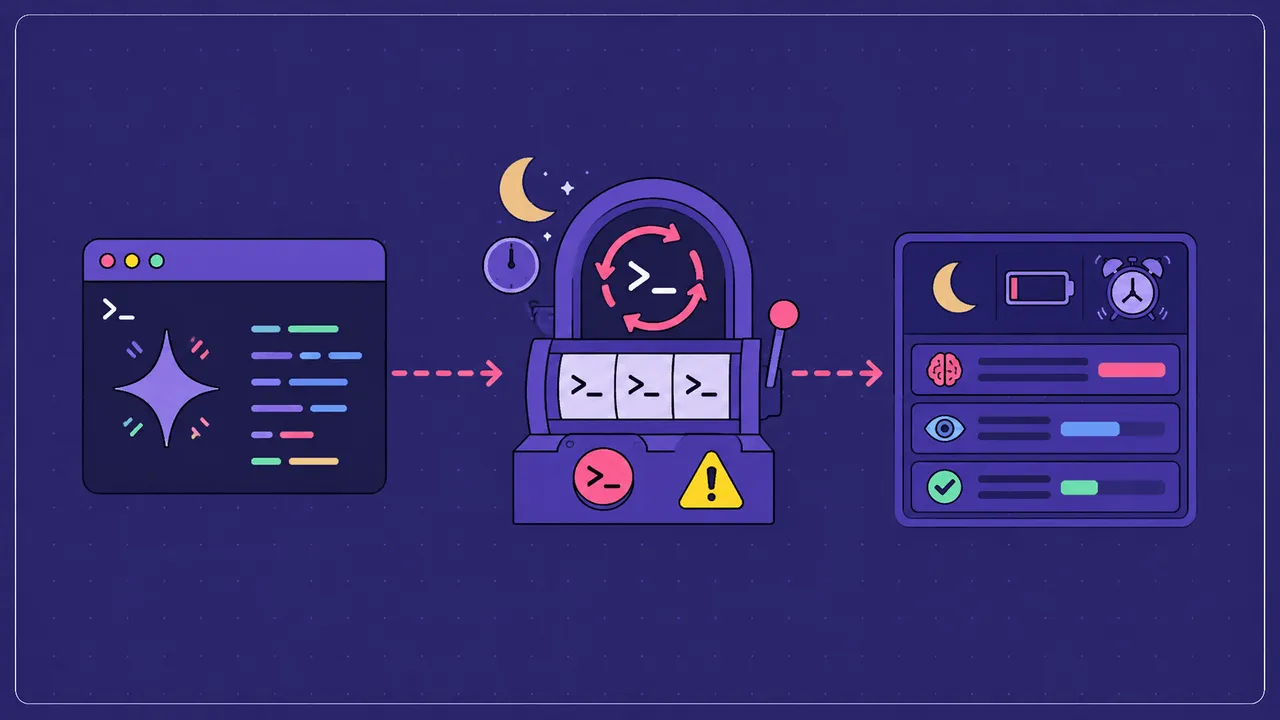
We were promised that AI would give us our time back. Instead, it is keeping us awake until 3 AM, staring at glowing terminals, chasing the illusion of a perfect one-shot refactor.
As the software industry shifts aggressively toward agentic loops, autonomous coding agents, and prompt-driven development, a silent burnout epidemic is sweeping through engineering teams worldwide. Recent industry data polling nearly 1,300 professional software engineers reveals an alarming reality: AI is not just accelerating how fast we ship code—it is fundamentally rewiring our mental health, disrupting our sleep cycles, and eroding our passion for programming.
Here is a deep dive into the psychological toll of AI coding, why prompt-driven development feels dangerously addictive, and how engineers can reclaim their sanity before burning out completely.
The AI Slot Machine: A Variable Reward Trap
Have you ever told yourself, “I’ll just run this prompt one more time,” only to look up and realize two hours vanished into thin air?
You are not alone. According to survey data, 46% of developers regularly blow past their intended stopping points when working with AI coding models and agentic workflows.
The underlying mechanism is rooted in behavioral psychology: the variable reward schedule.
Traditional software engineering is deterministic:
- You formulate an algorithm or architectural plan.
- You write the logic in your editor.
- You compile, test, and step through the debugger.
- It either succeeds or provides a stack trace with deterministic errors.
Prompting an LLM, however, is probabilistic. It operates identically to a casino slot machine. Sometimes you pull the lever and get hallucinated syntax errors and broken imports. Other times, the model hands you a flawless, 300-line drop-in solution that matches your codebase architecture with surgical precision.
That unpredictable anticipation triggers a sudden dopamine surge. Every time an agentic response streams into your IDE, your brain gets hooked on the possibility of an instant jackpot, compelling you to press the lever just one more time.
The inevitable consequence is acute sleep deprivation. Among developers who struggle to disengage from prompting loops, 58% report moderate to severe sleep disruptions, including racing thoughts, delayed bedtimes, and persistent screen insomnia.
More Output, Less Joy: The Developer Identity Crisis
Tools like GitHub Copilot, Claude Code, Cursor, and custom agentic frameworks have undeniably multiplied raw output. Yet that saved effort rarely translates into rest, shorter workweeks, or mental breathing room. Instead, it resets the baseline of expectations higher.
Because engineers can produce code ten times faster, organizations and individuals feel they must ship ten times faster. A staggering 65% of developers report feeling intense pressure to produce continuous output simply because AI makes velocity theoretically limitless.
We are rapidly transitioning from software craftsmen into triage managers who supervise thousands of automated, rapid-fire micro-decisions every single day.
This rapid shift has triggered a profound identity crisis across the engineering ecosystem:
- 59% of developers feel their manual coding skills and problem-solving intuition are actively diminishing.
- 54% report experiencing significantly less genuine enjoyment or psychological “flow” when building software compared to the pre-AI era.
There is a real neuroplasticity consequence at play. When you consistently outsource the difficult, analytical heavy-lifting of software design—the deep problem decomposition, edge-case analysis, and algorithmic synthesis—the brain naturally prunes those neural circuits over time.
The survey data confirms this direct correlation: developers who feel their foundational skills slipping are the exact same cohort reporting a complete loss of passion for software engineering.
The Multi-Agent Paradox: When Godlike Power Backfires
The initial thrill of running multiple autonomous agents simultaneously is intoxicating. Spawning three to five background agents to refactor modules, write test suites, and scaffold APIs creates a temporary feeling of godlike productivity.
During the first few weeks, developer excitement spikes. But as the sheer volume of generated code compounds, that euphoria collapses into maintenance fatigue.
The paradox of multi-agent workflows comes down to competitive baselines and cognitive load:
- The Moat Delusion: The realization that you can quickly scaffold forty products or features eventually meets a cold reality: every other developer has access to the exact same models. When speed becomes commoditized, volume alone creates no durable advantage.
- Review Debt: Human brains cannot reliably audit tens of thousands of lines of machine-generated code across multiple parallel threads. You become a bottleneck holding together a chaotic hive of automated workers, constantly paranoid about subtle security flaws, subtle edge-case regressions, and architectural drift.
How to Build a Sustainable AI Workflow
Surviving the AI coding era without destroying your mental health requires moving beyond vague notions of personal willpower. You need rigid, systematic guardrails built into your daily development environment.
1. Stop “Vibe Coding” and Start Architecting
Do not let the model drive your technical direction. Treat the LLM like an eager junior engineer who executes instructions but lacks systems intuition. You write the rigid specification, define the invariants, structure the data contracts, and review every diff critically. Maintaining human ownership over the architecture protects your cognitive skills and preserves the genuine satisfaction of building.
2. Enforce the 15-Minute Rule
If you find yourself stuck in a prompting spiral—rephrasing instructions, arguing with the context window, and chasing minor tweaks—set a strict 15-minute timer. If the agent does not produce a working solution within that window, stop prompting immediately. Close the AI pane and write the implementation manually. Breaking the probabilistic slot machine loop is the single most effective way to eliminate prompt addiction.
3. Establish Hard Environmental Boundaries
Keep AI coding apps, web interfaces, and Slack bot triggers off your personal phone and tablets. Configure physical or smart-home automation to dim your office lights at the end of the workday. When your work hours conclude, close your laptop and physically step away from the machine.
4. Increase Vertical Ambition, Not Horizontal Noise
Instead of using AI agents to churn out a dozen surface-level side projects or bloated features, redirect that computational leverage toward deep technical moats. Focus on performance optimization, rigorous formal verification, rock-solid security boundaries, and resilient distributed architectures.
The Verdict
AI coding tools are the most powerful levers we’ve ever had, but they are unforgiving to those without boundaries. If we don’t start protecting our time, our sleep, and our craft, the temporary productivity gains won’t matter—because we’ll be too burnt out to write the next prompt.