Vercel's New Programming Language (And It's Not For Humans)
A look at Vercel Labs' new Zerolang, the pain points of forcing AI to write human code, and why machine-native languages are worth watching.
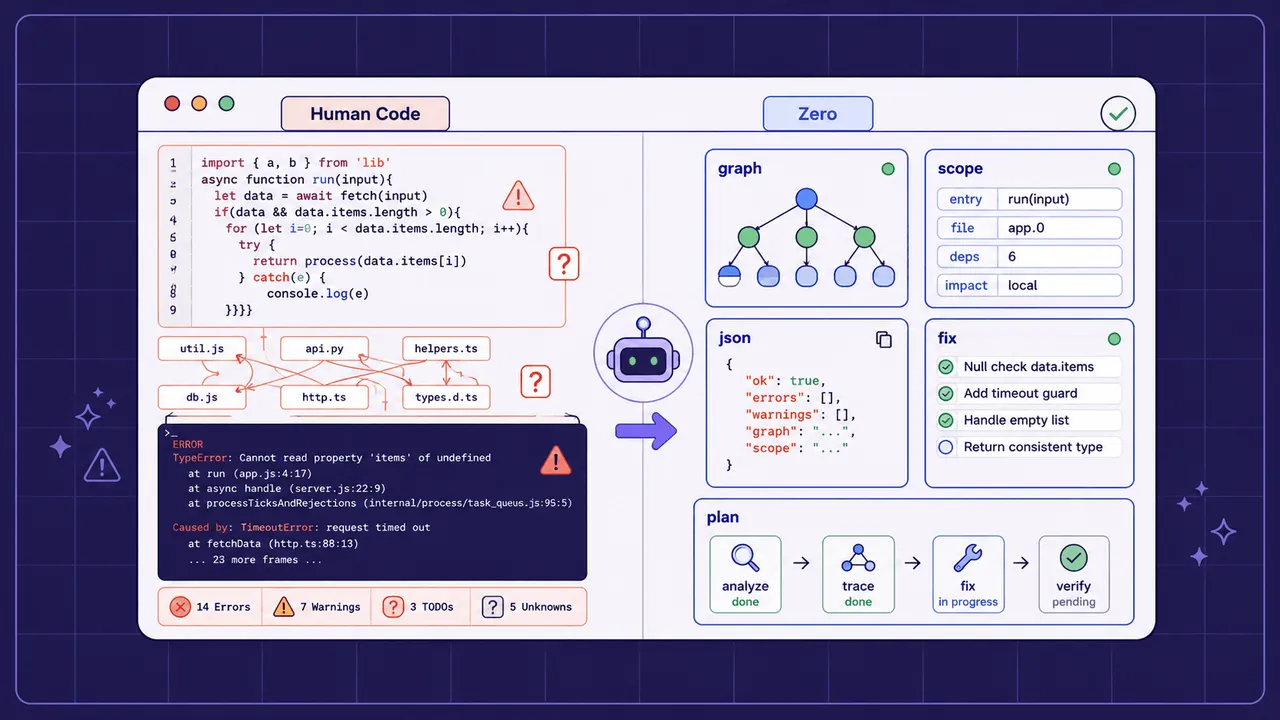
In the world of AI coding, we are still trying to fit a square peg into a round hole. For the last few years, we’ve been forcing LLM agents to write Python, JavaScript, and Rust. It feels like magic when it works, but let’s be honest: after hours of watching an agent get stuck in a loop trying to fix a cryptic Webpack error or hallucinate an NPM dependency, the honeymoon phase is officially over.
Enter Zero (or zerolang).
It’s an experimental new project from Vercel Labs that has been making waves in AI circles, and it makes a bold claim: we need to stop forcing machines to write languages designed for humans.
The “Human Syntax” Problem
We’ve all been there. You ask an AI agent to build a simple feature. It writes the code, but something breaks. In traditional languages, that usually results in an error message that looks like a decoded transmission from an alien planet: Uncaught TypeError: undefined is not a function.
Those languages and their tooling were built for us. They feature syntactic sugar to save our fingers from typing. They rely on massive dependency trees because humans like modular packages. When a compiler throws an error, it prints a human-readable string to a terminal.
But for an AI agent, syntactic sugar is just another abstraction to untangle. Human-readable text errors require precious token context to parse and interpret. We’ve spent years training AI models to parse our complex human environments, but why?
What is Zero?
Zero is an experiment in building an agent-first programming language from day one. It is a systems language built entirely around the needs of autonomous agents. The core philosophy of Zero is simple: let machines be machines.
Instead of optimizing for developer experience (DX), Zero optimizes for “agent experience.” Here is how that plays out in the language design:
- Regularity over syntax: Zero intentionally prefers one obvious, explicit way to express most things. There are no clever one-liners or shorthand syntax tricks. The code might look more verbose to a human eye, but it’s mathematically simpler for an LLM to generate without making logical leaps.
- A massive standard library: Instead of forcing an agent to search the internet for the right dependency, guess its version, and debug compatibility issues, Zero aims to provide a standard library broad enough that most programs don’t require external packages at all.
The Secret Sauce: Structured Determinism
If Zero were just a verbose language with a big standard library, it might not be worth the hype. But the reason it’s interesting is its deterministic, machine-first tooling.
Zero doesn’t just print text to a terminal. The tooling is built to expose structured facts. Commands like zero graph --json or zero explain output rich JSON. When an agent writes code that fails, the compiler doesn’t just complain—it hands the agent precise graph facts, scope diagnostics, size reports, and structured fix plans.
It creates a closed, deterministic loop where the agent and the compiler speak the exact same structured language. The agent can seamlessly inspect and repair the code without having to guess what a text-based stack trace implies.
Is it time to ditch Python and JS?
Before we all go running to rewrite our agent frameworks in Zero, let’s get real for a second. Our current languages aren’t just syntax; they are massive ecosystems.
Decades of Python and JavaScript mean decades of battle-tested libraries, SDKs, and runtime optimizations. Zero cannot replicate the entire NumPy or React ecosystems overnight.
Furthermore, Zero is strictly in the early experimental phase. Vercel Labs warns that it is pre-v1.0, intentionally unstable, and expects breaking changes. They actively advise against using it for production systems or sensitive data right now, explicitly noting that security vulnerabilities should be expected.
The Verdict
Is Zero the language that will replace Python for AI? Probably not this year. But it represents a massive and necessary shift in how we think about the future of software architecture.
We are moving away from thinking of AI as just a “fast junior developer” who types out human code, and moving toward a future where AI has its own native, optimized mediums.
If you’re tired of watching your agents hallucinate dependencies and want to see what an AI-native runtime looks like, Vercel Labs’ zerolang is definitely a project to watch. At the very least, it’s a reminder that just because we’ve built programming languages for humans for the last 70 years, that does not mean it’s the best way forever.