The End of "Vibe Coding": Why Spec-Driven Development is Taking Over AI
Why the AI honeymoon phase is fading into a new era of Spec-Driven Development, and how tools like Kiro, Traycer.ai, and Cursor are shifting developers from typists to architects.
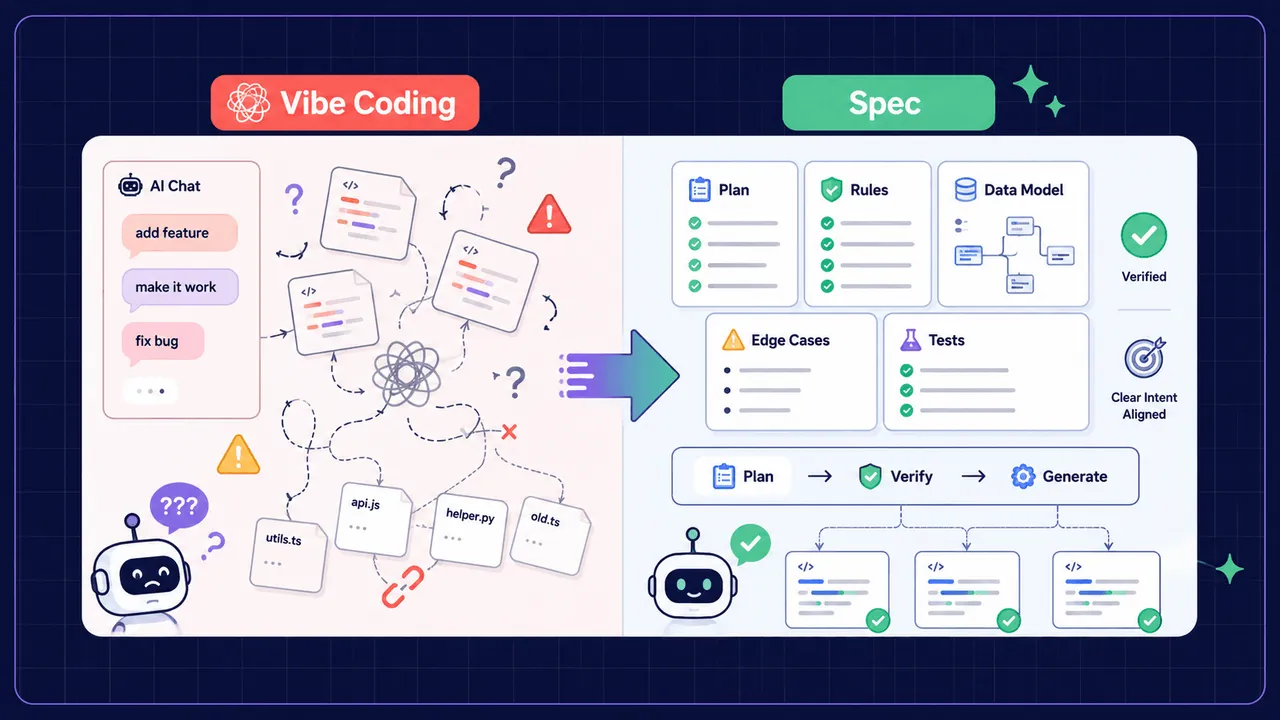
For the last couple of years, the software engineering world has been swept up in a trend affectionately known as “vibe coding.”
The premise was intoxicating: open your IDE, type “add a photo sharing feature to my app” into a chat window, and watch as an LLM writes the code. For weekend prototypes and simple scripts, it felt like magic. But as teams tried to scale this approach to complex, enterprise-grade systems, reality set in.
The AI had to guess the permissions model. It hallucinated the cloud storage implementation. It made dozens of unstated assumptions, resulting in plausible-looking code that fundamentally misunderstood the business logic. We realized that relying on loose, conversational prompts leads to massive architectural drift and unmaintainable codebases.
The industry is now recognizing that AI doesn’t need a casual chat. It needs a contract.
Enter Spec-Driven Development (SDD).
What is Spec-Driven Development?
Spec-Driven Development inverts the traditional Agile workflow. For decades, the code—whatever it actually ended up doing in production—was the de facto source of truth. Requirements documents drifted, design diagrams rotted, but the code was reality.
SDD flips this model. In the age of AI coding assistants, the specification becomes the primary, authoritative artifact. Developers write unambiguous, executable contracts of intended behavior, and the AI agent generates, implements, and verifies the code against that spec.
Instead of code-first and document-never, you plan the architecture, edge cases, and data models upfront. The AI acts as the compiler for human intent.
The Tooling Shift: From Chat to Plan
We are seeing a massive shift in how developer tools are being built to support this new paradigm. The days of simple “autocomplete” are fading, replaced by agentic loops that enforce a “Plan-Verify-Generate” workflow.
If you look at the bleeding edge of developer tooling right now, they are all converging on SDD:
- Cursor’s “Plan Mode”: Rather than blindly streaming tokens into your editor, Cursor and other advanced IDEs are prioritizing “planning modes.” The agent analyzes the codebase, generates a step-by-step specification of the changes it intends to make, waits for the human developer to review and approve the blueprint, and only then generates the code.
- Kiro IDE: Billed as an “intent-driven IDE,” Kiro structures development around layers of intent and execution, forcing a structured approach to what the AI is supposed to build before a single file is touched.
- Extensions like Traycer.ai: Tools like Traycer are pushing hard into the SDD space, turning natural language requirements into rigid, verifiable architectures that AI agents can systematically execute against without hallucinating off-path.
These tools represent a shift from ad hoc prompting to methodology encoding—systematically translating a project’s architecture, patterns, and quality gates into constraints that the AI cannot ignore.
Why This is the Future
When an AI tries to hold an entire enterprise codebase in its context window and make changes based on a “vibe,” it fails. It modifies dozens of files when only three were needed, creating unreviewed, unowned code.
By forcing a Spec-Driven Development lifecycle, we solve the two biggest bottlenecks of AI engineering:
- Context Pressure: A semantic specification or architectural plan is far smaller than raw code, allowing the AI to understand the exact constraints without being overwhelmed by token limits.
- Human Verification: You cannot easily review 3,000 lines of AI-generated code. You can review a 1-page structured specification. Once the spec is verified, the generation step becomes a deterministic execution rather than a creative guessing game.
The Verdict
We are officially leaving the era of the “AI typist” and entering the era of the “AI compiler.”
If your team is still relying on ad-hoc chat prompts to build production software, you are structurally exposed to technical debt and architectural rot. The future of software engineering isn’t about typing faster; it’s about thinking clearer. Developers are no longer just writing logic—we are becoming system architects, writing the specifications that machines will bring to life.
The code is no longer the king. The spec is.