Claude Fable 5 & Mythos 5: Anthropic’s Most Powerful AI is Guarded, Gated, and Genuinely Impressive
A deep dive into Anthropic's new two-tier frontier models: Claude Fable 5 and Mythos 5. We break down the capabilities, the aggressive safety classifiers, and the friction for developers.
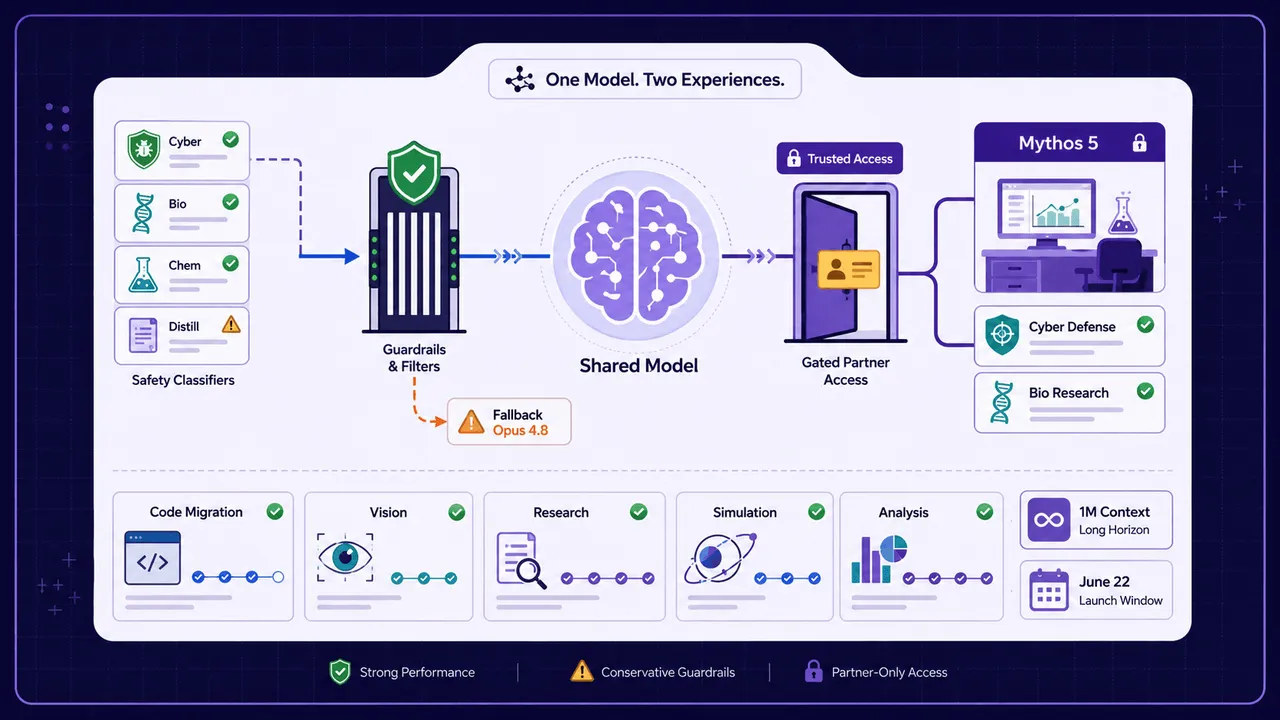
Earlier this week on June 9, Anthropic released Claude Fable 5, the first “Mythos-class” model made available to the general public. Alongside it came Claude Mythos 5, the exact same underlying model but with far fewer restrictions—reserved entirely for a small circle of vetted partners working on cybersecurity and biomedical research.
If you’ve been following the shift from casual “vibe coding” to structured, agentic workflows, this release feels like a genuine inflection point. Fable 5 isn’t just incrementally better at chatting or generating code snippets. It handles long-horizon, multi-step workflows in ways that actually compress real engineering timelines.
But it also introduces a controversial new paradigm: shipping one frontier model as two distinct products, separated entirely by an aggressive layer of safety classifiers.
Same Model, Two Very Different Experiences
Fable 5 and Mythos 5 share the same weights, the same 1-million-token context window, and the same massive 128,000-token output limit. Furthermore, both models feature Anthropic’s new “adaptive thinking,” which is permanently enabled by default.
The difference lies entirely in the safety layer Anthropic wrapped around Fable.
Fable 5 includes built-in safety classifiers that monitor for queries related to cybersecurity, biology, chemistry, and model distillation. When triggered, the model does not outright refuse the prompt. Instead, it seamlessly falls back to the weaker Claude Opus 4.8 to fulfill the request, notifying the user that the handoff occurred.
Anthropic acknowledges that these classifiers are highly conservative by design. They are tuned to block zero harmful requests in red-teaming, which inevitably leads to false positives on harmless queries.
Mythos 5 removes those guardrails. It is available only through Project Glasswing (Anthropic’s vetted partner program) for government cyber defenders and critical infrastructure operators. For the rest of the developer ecosystem—whether you are using the Claude API, Amazon Bedrock, or Databricks—Fable 5 is what you get.
The Performance Claims Hold Up
Anthropic’s benchmarks and early customer feedback paint a consistent picture: Fable 5 pulls ahead most noticeably on complex, long-running tasks that require sustained autonomy.
- Software Engineering: During early testing, Stripe reported that Fable 5 completed a codebase-wide migration on a 50-million-line Ruby monolith in a single day—work that previously took a team over two months.
- Agentic Autonomy: Databricks highlighted Fable 5’s ability to sustain productive output over multi-day, goal-directed runs. It doesn’t just write functions; it coordinates parallel sub-agents, debugs its own errors, and executes across tools with minimal human hand-holding.
- Vision and Interaction: One of the more striking internal demos showed Fable 5 playing Pokémon FireRed from raw screenshots alone, with no maps or game-state memory injected. It has also proven highly adept at rebuilding web app source code directly from UI screenshots.
The pattern across the board is that the longer and more open-ended the task, the larger the gap between Fable 5 and previous Opus models.
The Friction Is Real
However, capability this high doesn’t come without trade-offs. Early user reports are highlighting significant friction points in the day-to-day developer experience.
The “Opus Fallback” Unpredictability: The safety classifiers are aggressive. Developers have shared examples of being routed back to Opus 4.8 for prompts that feel completely benign—questions about low-level systems architecture, innocuous biology queries, and even some general data scraping tasks. While the fallback rate is reportedly under 5% overall, for teams working in security-adjacent or scientific fields, it introduces unpredictable performance drops.
The Pricing and Access Window: Fable 5 is not cheap. Priced at $10 per million input tokens and $50 per million output tokens, it is roughly double the cost of Opus 4.8.
Currently, Anthropic is offering a free evaluation window: Fable 5 is included in Pro, Max, Team, and seat-based Enterprise plans at no extra cost. However, this ends on June 22, 2026. After that date, Fable 5 access on consumer plans shifts to metered usage credits. Many individual power users are questioning whether the economics will make sense for everyday heavy use once the free window closes.
What This Actually Means for How We Build
For teams already moving toward Spec-Driven Development, Fable 5 looks like a massive accelerator. The ability to maintain coherent state across massive contexts, reflect on outputs, and handle unfamiliar tools makes true AI engineering viable beyond toy projects.
At the same time, this release accelerates the conversation about tiered AI access. We now have a publicly documented split between a “safe for general use” frontier model and an unrestricted version locked behind corporate and government vetting. That structure was likely inevitable as models crossed the threshold into offensive cyber capabilities, but seeing it implemented this visibly still feels like a massive shift for the open web.
The Verdict
Claude Fable 5 delivers on the promise of Mythos-class performance for everyday users. The engineering and reasoning gains are very real, especially for ambitious, multi-hour workflows.
But it’s not a clean “just use this now” upgrade. The aggressive fallback behavior, the June 22 subscription cutoff, and the higher per-token cost mean that Opus 4.8 (or cheaper models like Sonnet) will remain the pragmatic daily driver for routine tasks.
If you’re doing serious agentic coding, complex data analysis, or long-context architectural work, Fable 5 is absolutely worth testing immediately—especially while it is still included in flat-rate plans. The frontier of AI just got significantly more powerful, but the guardrails dictating how we use it just got a lot more sophisticated.