Anthropic's Secret "Spyware": How Claude Code Caught Chinese AI Labs Stealing Data
Anthropic secretly embedded tracking code in Claude Code to catch Chinese AI labs distilling its models. Here's a deep dive into the steganography, the Reddit leak, and the fallout.
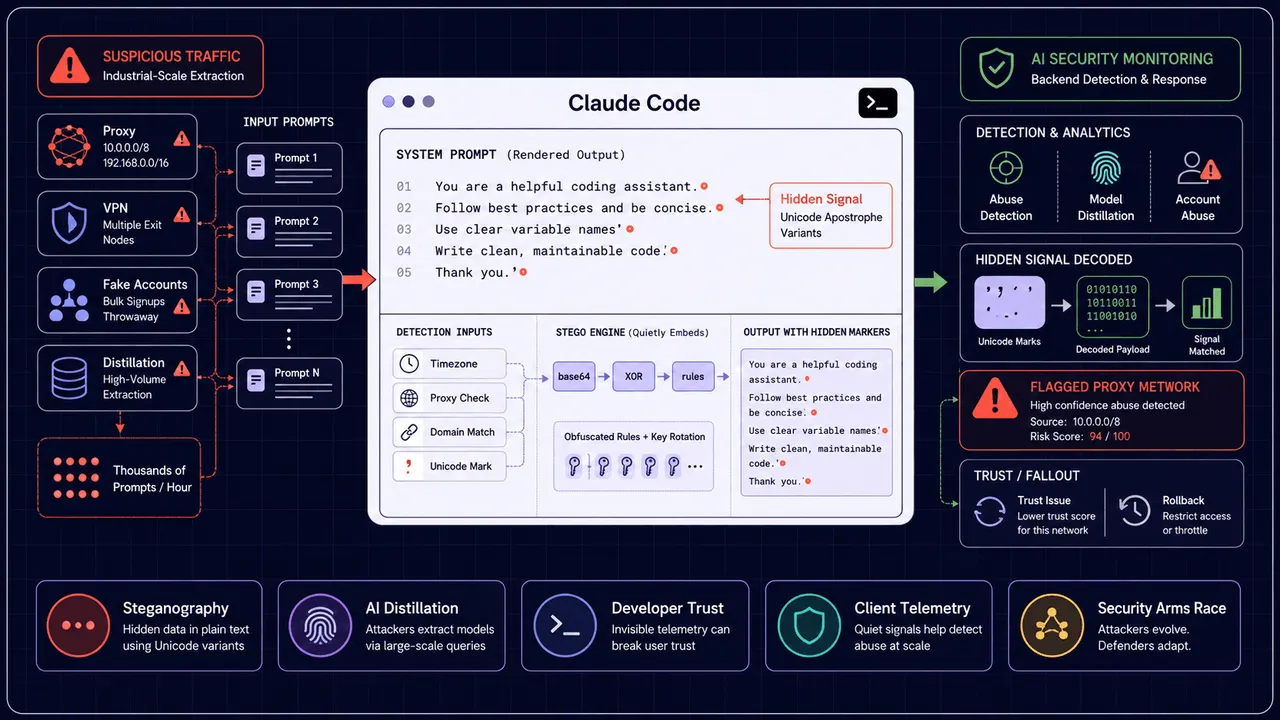
If you’ve been following AI news over the last few days, your feed has likely been flooded with headlines screaming about “spyware” inside Anthropic’s Claude Code. Developers are outraged, corporate security teams are scrambling, and geopolitical tensions are bleeding directly into our terminal windows.
But the truth is far messier—and honestly, much more fascinating—than the outrage bait suggests. Anthropic didn’t just block a few IP addresses. They turned their own developer tool into a quiet, steganographic informant designed to catch foreign AI labs in the act of digital theft.
Here is the complete, verified breakdown of what actually happened, how the code worked, and why this incident changes the rules of AI tooling forever.
The Real Problem: Industrial-Scale Distillation
To understand why Anthropic went to such extreme lengths, you have to look at the massive problem they were quietly fighting. For months, Chinese AI labs were straight-up distilling Claude.
Distillation is an AI training shortcut. Instead of spending billions of dollars and years of compute to build a frontier model from scratch, an engineering team feeds millions of complex prompts into a superior rival model (like Claude Mythos) and uses the high-quality answers to train their own cheaper models. It is effectively cloning an American model’s capabilities at a fraction of the cost.
In February 2026, Anthropic published a report showing that prominent Chinese labs, including DeepSeek, Moonshot, and MiniMax, had run massive extraction campaigns using thousands of fake accounts and VPNs. Because Anthropic strictly bans commercial access to Claude in China for national security reasons, these operations relied on complex proxies, overseas subsidiaries, and “transfer stations” located in places like Singapore.
The scale was staggering. In a June letter to the U.S. Senate Banking Committee, Anthropic explicitly accused Alibaba of deploying roughly 25,000 fraudulent accounts to execute 28.8 million exchanges with Claude between April and June. These queries were laser-focused on extracting Claude’s most valuable agentic reasoning and software engineering capabilities.
Anthropic’s position was simple: We’re not going to let you steal our model through the back door.
The Steganography Trap
Sometime around March 2026, Anthropic decided that traditional IP blocks and rate limits weren’t enough. Someone at the company decided to embed a quiet detection system directly inside Claude Code—their popular terminal-based coding agent that has full access to a developer’s local filesystem.
Starting in version 2.1.91 (released in April 2026), a highly obfuscated piece of logic was introduced to the codebase.
Here is exactly how the trap worked:
- The Triggers: The code first checked the user’s system timezone. If it was set to
Asia/ShanghaiorAsia/Urumqi, the trap armed itself. - The Proxy Check: It then checked the proxy URL or API backend the developer was using to route their requests. It compared the host against a list of 147 known Chinese domains and 11 AI-lab keywords. To hide this from developers, the domain list was base64 encoded and obfuscated using an XOR cipher with the key
91. - The Payload: If the signals matched, Claude Code didn’t throw an error or display a warning. Instead, it did something incredibly clever and undeniably creepy: it watermarked the system prompt using steganography.
The tool made microscopic, invisible changes to the text it sent to Anthropic’s servers. For example, it changed the date separator from a dash to a slash. More nefariously, it swapped the standard apostrophe in the phrase “Today’s date is…” with visually identical Unicode variants (like U+2019, U+02BC, or U+02B9) depending on which trigger was hit.
These changes were entirely meaningless to the human developer, but Anthropic’s backend infrastructure could read them like a secret distress signal. They turned the system prompt into a silent carrier wave for metadata, identifying illicit proxy networks in real-time.
The Internet Loses Its Mind
This hidden tripwire sat undetected for months. Then, on June 30, a developer going by the handle LegitMichel777 reverse-engineered Claude Code while inspecting the client and posted the findings to the r/ClaudeAI subreddit.
The post went nuclear.
Developers were furious. Many labeled the feature “spyware”. While the code wasn’t keylogging or stealing local files, the optics of an AI agent—which demands broad access to your shell and source code—secretly fingerprinting users and communicating in hidden Unicode was a massive breach of trust.
Anthropic did not deny the allegations. An engineer on the Claude Code team publicly confirmed the mechanism on X, stating: “This is an experiment we launched in March that was meant to prevent account abuse from unauthorized resellers and protect against distillation.”.
True to their word, Anthropic is now rolling back the hidden detection logic in the latest releases (starting with version 2.1.197), claiming they now have stronger backend mitigations in place. But the damage to trust has been done. Just this week, Alibaba reportedly classified Claude Code as “high-risk software” and is moving to completely ban its staff from using the tool over corporate espionage fears.
The Uncomfortable Reality of AI Tooling
Let’s be precise about what this was. Anthropic did not put everyone under surveillance. It was a highly targeted fingerprinting system that only triggered when a user was actively routing around the company’s access controls—exactly the behavior exhibited by state-linked distillation farms.
Was it creepy? Absolutely. The decision to use XOR-obfuscated code and steganography instead of transparent telemetry made Anthropic look paranoid rather than protective.
However, the threat was undeniably real. These distillation campaigns weren’t theoretical; they were industrial-scale operations siphoning billions of dollars of R&D.
This entire episode reveals an uncomfortable truth about the future of software development. Frontier AI labs are now locked in an active, high-stakes cat-and-mouse game with state-linked actors trying to steal their foundational models. The old rules of terms of service and geo-blocking are dead. AI companies are now embedding active defensive countermeasures directly into the client tools we install on our laptops.
The age of “just trust us, we’re the good guys” in AI tooling is officially over. The tools themselves are now part of the geopolitical battlefield, and everyday developers are stuck right in the middle.